
How to Plan a 5-Day Golden Triangle Tour (Delhi-Agra-Jaipur)

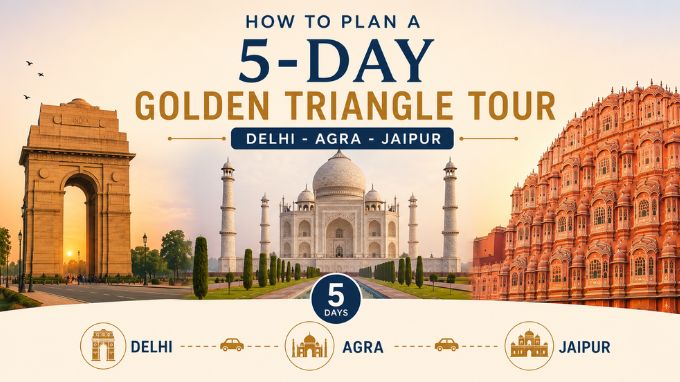
The 5 day tour of the Golden Triangle is the most popular way for international travelers to see India and it deserves to be that popular! With 3 cities each having completely different characters and creating a manageable loop throughout northern India. Delhi has a rich history and Agra has one of the Seven Wonders of the World (the Taj Mahal) while Jaipur has many forts and the original Old City (which is all pink walls). Five days will go by quickly but it will give you ample opportunity to visit the key sights without fast-tracking your time through them.
This Golden Triangle itinerary has been created based upon what truly works day-by-day; not based on what looks great on paper.
Before You Start: What to Know About the Route
The classic Delhi – Agra – Jaipur circuit is approximately 720 km long and has three legs:
Leg 1: Delhi to Agra: 200 km (3.5-4 hours by road; 1 hour 40 minutes by Gatimaan Express)
Leg 2: Agra to Jaipur: 240 km (4-5 hours by road, with a stop at Fatehpur Sikri)
Leg 3: Jaipur to Delhi: 280 km (5-6 hours by road; 4.5 hours by train on the Shatabdi)
The best time to visit the cities on the circuit is from October to March. During this time, the weather is pleasant (temperature range of 15-30 degrees Celsius); the air quality is high; and the light conditions are excellent for photographs. Conversely, the months of April and May in India have extremely high temperatures that can greatly hinder your ability to do outdoor activities.
Most travelers who complete this circuit over a 5-day period will typically hire a private car and driver for the entire duration (costs between $300-$500). This type of transportation allows the traveler to not worry about the logistics associated with using trains between cities, particularly with respect to transporting luggage. The Gatimaan Express train between Delhi and Agra is an excellent option for budget travelers; similarly, there are many great options for budget travelers on the Shatabdi from Jaipur back to Delhi.
Day 1: Arrive in Delhi — Easy Start
Make sure to take your time arriving and settling in after your long journey. The jet lag can be heavy going: give yourself a couple of hours to get ready for Day 1. You could treat yourself to Lodi Gardens if you feel decently energetic when you arrive at around lunchtime or in the afternoon: there are tombs dating from the Mughal Empire to explore, as well as lovely long paths that could give you the impression of having arrived somewhere interesting, and the gardens themselves are fairly large enough that no matter where you start out, you won’t be as far away as it may seem at the beginning of your visit. While this is not the main thing you will want to see or do, it does set the stage for what’s ahead.
If you want to spend some time eating dinner, then again stay close to your hotel. If you’re staying in Khan Market, you will find plenty of restaurants serving Indian and Italian cuisine, among other options. If you want to make this a memorable first meal, I recommend Bukhara at ITC Maurya. They have one of the best dishes in India (dal bukhara), and there is nothing wrong with starting your trip off with a bang!
For accommodations: The Lalit New Delhi; The Claridges; or Roseate House for a mid-range hotel. Taj Mahal Hotel (not the monument!) on Mansingh Road; or The Leela Palace for a luxury hotel.
Day 2: Old and New Delhi — Full Day in the Capital
Morning in Old Delhi, afternoon at some of the highlights from New Delhi.
Starting the day – the visit to Jama Masjid – is one of the largest mosques in South Asia and was built back in 1656 by Shah Jahan (who was also responsible for the construction of the Taj Mahal). You are allowed to enter the mosque when prayers are not being held, and if you would like, you can climb up the minaret for a breathtaking view of Old Delhi’s winding streets and power lines.
After touring Jama Masjid, proceed to Chandni Chowk, which offers the complete Old Delhi experience. At Chandni Chowk you’ll be confronted with the sensory overload that is synonymous with Old Delhi. It’s a cauldron of commotion, with narrow streets filled with busy cycle-rickshaws, vendors, spice shops and the true test of your palate with the flavours and scents of Old Delhi. Don’t miss visiting Parantha Wali Gali, where families have been serving up fried stuffed flat bread for many generations.
Afternoon: Humayun’s Tomb and Red Fort
The Red Fort (also called Lal Qila), was built in the 1600s by Emperor Shah Jahan who built the Taj Mahal as well. Entry fee for foreigners is ₹600/($6.67). Plan to spend about 1 1/2 hours at the Red Fort.
Once finished, you will head to the south to visit Humayun’s Tomb — another UNESCO World Heritage Site. It was the first building to closely resemble what would be built as the Taj Mahal. Although not as well-known, much less crowded, and just as beautiful. The entry fee for foreigners is the same ₹600/($6.67) for foreigners but the gardens alone make the trip worth it.
Have dinner where you stay and go to bed early since you have a train or car leaving for Agra early in the morning.
Day 3: Delhi to Agra — Taj Mahal Day
Get to the Taj Mahal early in the day, and train or drive to get there. The Gatiman Express leaves from Hazrat Nizamuddin around 8:10 AM and gets to Agra about 10:30 AM. If driving, leave around 6:30 AM to arrive at the Taj Mahal in Agra before 10:30 AM. Check-in at your hotel (a good place to eat lunch is near the Taj Mahal near the East Gate, such as Sheroes Hangout Cafe, a cafe run by acid attack survivors and offering good food and strong coffee, which supports an excellent cause).
For the best lighting for photos of the Taj Mahal, go inside the Taj Mahal between 2-2:30 PM after you have eaten lunch and checked in. The light on the Taj Mahal later in the afternoon is different from the harsh white light of the middle of the day; in the late afternoon, it is softer and more golden-toned. Additionally, the crowds are generally smaller in the late afternoon than they are from 10 AM to 12 PM, when all the tour bus groups are there.
The entry fee for outside nationals is ₹1,300 or approximately $16, plus ₹200 for the mausoleum’s interior. Both of these fees are worth it. If you do not already have a guide set up, you can get a licensed guide from the East Gate ticket window (they will really help you).
The Taj Mahal closes one hour before sunset; you will need about 2.5–3 hours to see everything inside the Taj complex.
Spend the night in Agra; there are several hotels, such as the Trident Agra, which has good value at mid-range prices, and the Oberoi Amarvilas, which has no budgets as they have Taj-reovolta from all rooms.
Day 4: Agra to Jaipur via Fatehpur Sikri
Agra Morning, Jaipur Afternoon
Agra Fort (8:30 – 10:30 AM)
Another important monument in the city is Agra Fort and it alone deserves a couple of hours to explore. The entry fee is ₹650 (approx. $8) for foreigners. This is where many of the Mughal emperors spent part of their reign for 200 years, and inside the fort there is a balcony that shows the view of the Taj Mahal that Shah Jahan had while his son imprisoned him. This fact alone gives this place a different perspective.
Itmad-ud-Daulah Mausoleum (30 – 45 Minutes)
The Itmad-ud-Daulah mausoleum is nicknamed Baby Taj and is often overlooked when people come to India for 5 days because they run out of things to do. Don’t skip it! It was built before the Taj Mahal and has some of the most beautiful inlaid marble anywhere. It costs ₹310 to enter, but you will have a quiet atmosphere and will have time to enjoy all the beauty very slowly.
Afternoon: Fatehpur Sikri (Located En Route to Jaipur)
Located about 40 km from Agra on the road to Jaipur, Fatehpur Sikri is an entirely abandoned city created by the Mughal emperor Akbar in the 1570s but left to deteriorate after approximately 14 years. Admission: Approximately ₹610 (approx. $7.50). You should budget about 1.5 hours for your visit here. One of the most magnificent examples of Mughal architecture you will encounter along the entire Delhi to Agra to Jaipur route is the Buland Darwaza.
You can expect to arrive in Jaipur between 7:00 PM and 8:00 PM and be able to recline for the evening.
Accommodations in Jaipur: For a great mid-range stay at a heritage property experience, consider Alsisar Haveli or Samode Haveli; for a luxurious full-service experience, choose Rambagh Palace.
Day 5: Jaipur — Pink City Highlights, Then Back to Delhi
Day Tour – Jaipur
Morning – Visit Amer Fort (8:30 am to 10:30 am) – Visit Amer Fort which is one of the premier attractions on the Golden Triangle route (Jaipur leg). The fort is located on top of a hill 11 km outside of the central city and is more enchanting than most people anticipate when visiting. The Sheesh Mahal (Hall of Mirrors) located within the fort uses the reflective quality of mirrors to reflect back into the room all sunlight which enters into the room. Amer Fort – Rate: 550R ($6.50).
Late Morning – Visit Hawa Mahal & City Palace (10:30 am to 12:30 am) – Hawa Mahal is a 5 story honeycomb design and is the ‘poster child’ for photographs in Jaipur and only takes approximately 30 minutes to tour. Hawa Mahal Admission Cost: 200R. City Palace is located next to Hawa Mahal and is worth visiting for 1 hour to 1.5 hours. City Palace has many intriguing items which are not commonly found in tourist locations including a textile museum and a weapons museum. City Palace Admission Cost: 700R.
After lunch, take a short stroll through Johari Bazaar. Jaipur has a reputation for its gemstones, block printed textiles, blue pottery and leather sandals. If you are purchasing anything on this trip, Johari Bazaar will be your best choice and bargaining is expected.
In the afternoon, you will return to Delhi. If using a car, plan to leave between 2 and 3 pm; the drive will take about 5 to 6 hours. The Shatabdi Express leaves Jaipur around 5:50 pm and arrives in New Delhi around 10:35 pm. This is perfect if your international flight is the following day.
Budget Overview for a 5-Day Golden Triangle Tour
| Expense | Budget | Mid-Range | Comfortable |
| Hotels (4 nights) | $200 | $500 | $1,200+ |
| Transport (full circuit) | $100 | $350 | $600 |
| Entry fees (all monuments) | $85/person | $85/person | $85/person |
| Food | $150 | $350 | $700 |
| Guides | $50 | $120 | $250 |
| Total per person | ~$400 | ~$900 | $2,000+ |
Frequently Asked Questions
Should I start in Delhi or fly to Jaipur?
Start in Delhi because the majority of international airlines land in Delhi, and the route from Delhi to Agra to Jaipur is a straight route and when you reach Jaipur, there are numerous low-cost airlines that can take you to the rest of India if you are planning on staying in other parts of India.
Should I book guides in advance?
No, but if you are going to visit Agra or Jaipur, then a guide is handy; you can arrange for a licensed guide through either your hotel or at the ticket counter for any site you want to visit.
What is the best transportation for traveling the entire circuit?
The best option for five days in a private car is the most complete option for a small group (of two to four people). If you are booking your own transportation, the train is the best option for specific legs of the circuit, (particularly Delhi-Agra).