
Best Time to Visit the Taj Mahal: Month-by-Month Guide (2025)

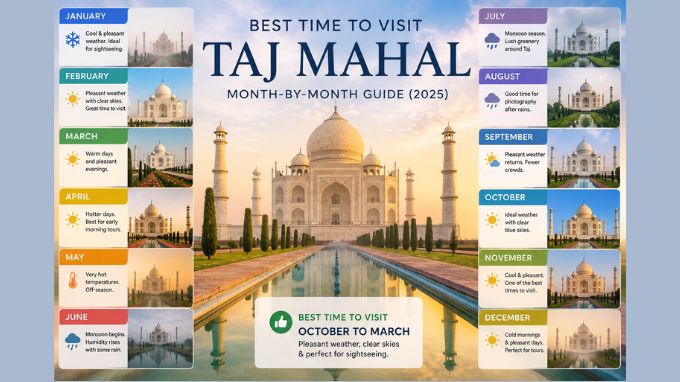
Here’s the honest answer: October through March. That’s when most people should go, and there’s a reason it’s the default recommendation from every travel site, guide, and tour operator.
But “most people” is doing a lot of work in that sentence. If you hate crowds, peak season is also the worst time in terms of foot traffic. If you’re a photographer, the monsoon haze creates conditions that make the Taj Mahal look completely different — softer, more dreamlike. If you’re on a tight budget, summer prices drop significantly.
So the better question isn’t when is the best time – it’s best time for what. This guide breaks it down month by month.
Taj Mahal at a Glance: Season Overview
| Season | Months | Weather | Crowds | Best For |
|---|---|---|---|---|
| Winter | Nov–Feb | 8–22°C, dry, clear | Very high | First-timers, photography, comfort |
| Spring | Mar–Apr | 20–35°C, dry | Moderate | Fewer crowds, still comfortable |
| Summer | May–Jun | 38–45°C, brutal | Low | Budget travelers, early risers |
| Monsoon | Jul–Sep | 25–35°C, humid, rainy | Low–Moderate | Unique atmosphere, lower prices |
| Post-Monsoon | Oct | 25–33°C, clearing | Growing | Good compromise month |
Month-by-Month Breakdown
January
Weather: Cold mornings (as low as 6°C / 43°F), mild afternoons (18–20°C). Fog is a real issue – dense ground fog in early January can reduce visibility significantly, sometimes hiding the Taj Mahal almost entirely for hours after dawn.
Crowds: Peak season, busy throughout the day.
Verdict: Great weather, but plan for fog. If you’re visiting in January, aim for a late-morning visit rather than sunrise – the fog often clears by 9–10am. Alternatively, book a hotel with a Taj Mahal view and watch it emerge from the mist, which is genuinely spectacular.
Best for: Travelers who don’t mind the cold and want comfortable daytime temperatures.
February
Weather: 10–24°C. One of the most pleasant months – cool mornings, warm afternoons, minimal fog compared to January. Visibility is usually excellent.
Crowds: Still peak season, busy but slightly less than December–January.
Verdict: Many experienced India travelers consider February the single best month for the Taj Mahal. The light is warm, the weather is comfortable enough to walk around for hours, and the fog risk has dropped. Book accommodation and trains in advance.
Best for: First-time visitors who can only go once and want the most reliable experience.
March
Weather: 15–32°C. Temperatures are rising but still manageable. The sky is clear and the light is excellent in the morning.
Crowds: Transitioning out of peak – noticeably fewer tourists than February, especially in the second half of the month.
Verdict: An underrated month. You get good weather, better photography conditions (cleaner light, fewer people in your frame), and lower prices on accommodation. The heat doesn’t become oppressive until April.
Best for: Photographers, travelers who dislike large crowds.
April
Weather: 22–38°C. Warm in the morning, genuinely hot by 11am. A sunrise visit is nearly essential at this point.
Crowds: Low to moderate. The drop-off from peak season is noticeable.
Verdict: April works if you start early. A sunrise Taj Mahal visit in April means 90 minutes of comfortable temperatures before the heat arrives. By 9am, you’ll want shade.
Best for: Travelers who want the Taj Mahal mostly to themselves and can handle heat with proper planning.
May
Weather: 30–45°C. Agra in May is genuinely hot. This is some of the harshest weather the subcontinent produces. Touching the white marble on the main platform by midday is uncomfortable – it absorbs and radiates heat intensely.
Crowds: Very low.
Verdict: Not recommended for most travelers. If you must visit in May, arrive at gate opening (around 5:00–5:15am), spend two hours, and leave. Hotels and tours are significantly cheaper.
Best for: Budget-focused travelers who don’t mind the heat and commit to an early start.
June
Weather: 32–43°C with pre-monsoon humidity building. First monsoon rains sometimes arrive late June.
Crowds: Very low.
Verdict: Similar to May – doable if you start early, but not comfortable. The upside is prices and availability are at their lowest point all year.
July
Weather: 28–36°C, frequent rain, high humidity. Monsoon arrives in full.
Crowds: Low to moderate, mostly domestic Indian tourists.
Verdict: The Taj Mahal in the monsoon looks different. The sky turns dark grey-blue, the white marble almost glows against it, and the gardens are intensely green from the rain. If you go in the dry window between showers – often the early morning – you can get photographs that look nothing like the standard postcard version. Worth considering if dramatic, moody imagery appeals to you.
Best for: Adventurous travelers, photographers who want something different.
August
Weather: 28–34°C, continued monsoon, high humidity.
Crowds: Low.
Verdict: Similar to July. The rain is less predictable in August – some days are clear, some are not. Independence Day (August 15) sees strong domestic tourism.
September
Weather: 25–35°C, monsoon tapering off in the second half. Humidity is high, but clearing.
Crowds: Beginning to pick up as the season transitions.
Verdict: The last week of September can be genuinely good – the rains are largely done, the landscape is still green, temperatures are lower than summer, and you beat the October rush by a few weeks.
October
Weather: 20–33°C. The transition month. First half is still warm and potentially hazy. Second half is much better – cooler mornings return, visibility improves.
Crowds: Growing through the month, especially from mid-October.
Verdict: The second half of October is when the good season genuinely begins. Comfortable temperatures, improving air quality, and you’re ahead of the main November–December rush. A solid choice.
November
Weather: 12–28°C. Clear skies, cool mornings, pleasant afternoons.
Crowds: High and growing.
Verdict: November is the classic peak month. The weather is reliably excellent – nearly every day is clear, the light quality is superb, and the temperature is what most travelers consider ideal. The downside is crowds. The Taj Mahal at 10am in November looks like a very busy airport. A sunrise visit is essential to avoid the worst of it.
Best for: First-time visitors who want the full, comfortable experience.
December
Weather: 8–22°C. Cool to cold, particularly at dawn when temperatures can approach 5°C. Fog risk increases in late December.
Crowds: Very high, including around Christmas and New Year’s.
Verdict: Beautiful in the daytime. The cold mornings are worth layering up for if you’re going at sunrise. Book everything – accommodation, trains, guided tours — weeks in advance. December is the single busiest month at the Taj Mahal.
Best for: Visitors who are traveling during the holiday season and don’t have flexibility on timing.
When Is the Best Time for Photography?
The two best windows for photography are:
Early morning, October–March: Warm, golden light at sunrise. The Taj Mahal shifts from pale pink to gold to brilliant white in the first 40–60 minutes after the gates open. This is the light most professional travel photographers plan around.
Monsoon mornings (July–September): Rare cloud formations, dramatic skies, the white marble contrasted against dark grey clouds. Completely different from the standard image, and harder to predict but when the conditions are right, the results are extraordinary.
The worst light for photography is midday, year-round. The marble becomes so reflective in direct overhead sun that detail disappears.
When Is the Best Time to Avoid Crowds?
If minimizing crowds is your priority:
- Best months: April, May (early morning only), September
- Best time of day: The first 60–90 minutes after gate opening, any month
- Worst time of day: 10am–2pm, especially October–February
The Taj Mahal receives approximately 7–8 million visitors per year. On a busy October Saturday, 40,000–50,000 people pass through. There is no time of year when it is genuinely empty but an April sunrise visit comes closest.
What to Wear by Season
| Season | Recommended |
|---|---|
| Nov–Feb | Layers — warm jacket for morning, lighter clothes for afternoon |
| Mar–Apr | Light cotton, sunscreen, hat |
| May–Jun | Lightest breathable cotton, strong sunscreen, hat, extra water |
| Jul–Sep | Light clothing, rain jacket or small umbrella |
Modest dress is appropriate covered shoulders and knees are respectful, particularly near the mosque. Shoes must be removed at the main mausoleum entrance; shoe covers are provided free.
Frequently Asked Questions
What is the absolute best month to visit the Taj Mahal?
February is the most consistently recommended single month. The fog risk from January has mostly passed, temperatures are comfortable all day, and the light quality in the morning is excellent. November is a close second but significantly more crowded.
Can you visit the Taj Mahal in the rain?
Yes. The complex stays open during light to moderate rain. The marble walkways become slippery when wet, so wear shoes with grip. The aesthetic rain-soaked white marble against dark monsoon sky is genuinely beautiful.
Is January too cold for the Taj Mahal?
Not too cold – daytime highs reach 18–20°C, which is comfortable. The main risk in January is dense fog that can obscure the Taj Mahal for hours in the morning. If visiting in January, consider a late-morning visit rather than sunrise.
Is summer (May–June) worth visiting the Taj Mahal?
Only with a very early start. The heat from 10am onward is genuinely harsh temperatures regularly exceed 42°C in May. A sunrise visit followed by a return to your hotel by 9am is entirely manageable. Avoid midday.
When does the Taj Mahal get the most beautiful light?
At sunrise from October to March. The warm, low-angle morning light turns the white marble shades of pink, peach, and gold before shifting to brilliant white as the sun rises. This window lasts about 45–60 minutes after the gates open.